

Do you know how many times a day I found myself saying “This is a tool, not a toy” to my students? If you teach students who need deep sensory input, you probably say it often too.
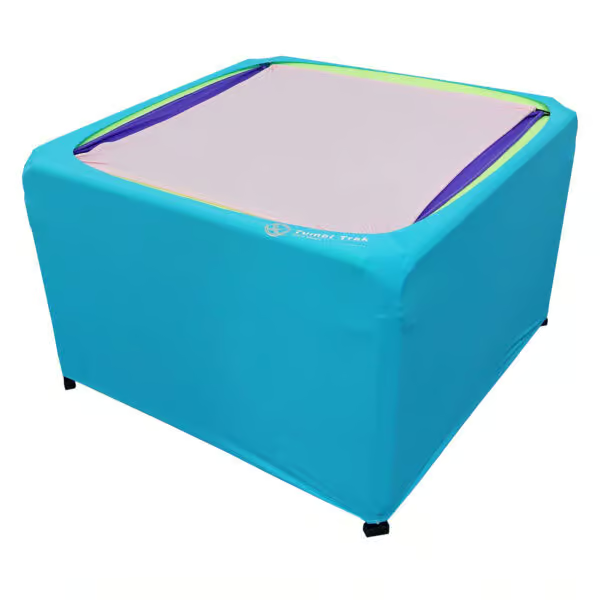
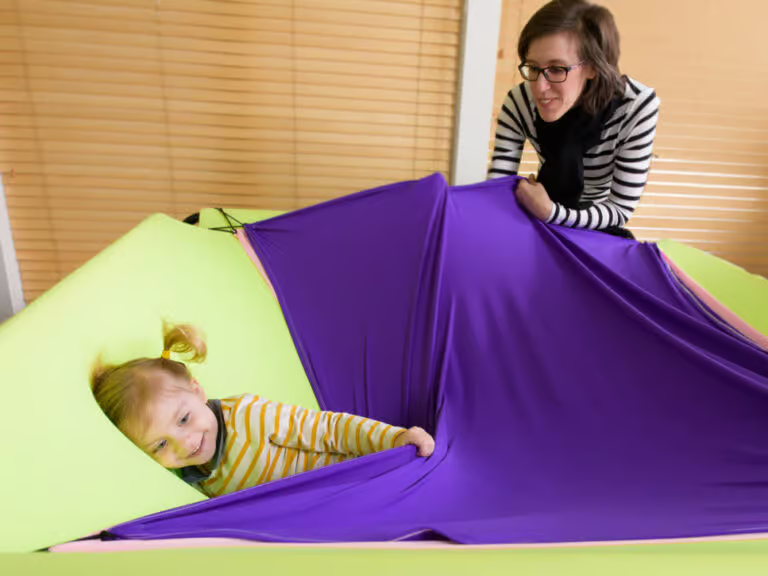
Let me start from the beginning. Back in 2021, when I was teaching in an intensive social and communication support classroom, I brought the Boundex Cuddle Box into my room. It’s a padded steel frame with three stretchy Lycra layers across the top and a Lycra skirt around the sides. My students used it in two very different ways. Some climbed on top to bounce and push against the layers when they needed to get energy out. Others crawled under the skirt into the hideaway when they needed to settle. Every one of them used it differently, and every one of them wanted a turn.
They loved it and would race to use it, which is exactly why I needed rules. Here is what worked in my room.
Five classroom rules for the Boundex
- Purpose over play. The rule: “We use this to help our bodies, not to play games.” In practice: the Boundex is for bouncing, pressure, or quiet time under the skirt, not for roughhousing.
- Body check-ins first. The rule: “Name what your body needs before stepping in.” In practice: teach students to say whether they need energizing input (bouncing on top) or calming input (resting underneath in the hideaway).
- Respect the timer. The rule: “Tools are shared on a timer so everyone’s body gets what it needs.” In practice: set a visual timer before a student gets on. Three to five minutes per turn worked in my room, so transition expectations were clear before the turn started.
- One at a time, with a teacher. The rule: “One person on the Boundex, and a teacher stays with you.” In practice: only one student used the Boundex at a time, an adult stayed with them the whole time, and before anyone climbed on top, we looked under the skirt to make sure no one was tucked underneath.
- If it becomes a toy, it takes a break. The rule: “If it becomes a toy, it takes a break.” In practice: if a student starts roughhousing, throwing things, or distracting others, quietly say, “It looks like this has turned into a toy right now. We’ll try using it as a tool again at our next sensory break.”
Why the boundary matters
Drawing a clear line between sensory tools and recreational toys gave my students a dependable way to get the input they needed and come back to learning. With concrete rules in place, the Boundex could do the job I brought it in for.
I work at Grow Through Movement now, but I found the Boundex as a teacher first, and these are the rules I’d hand to any teacher setting one up.